Conor Fearon, Roisin Lonergan, Damien Ferguson, Susan Byrne, David Bradley, Yvonne Langan, Janice Redmond; Neurology 2020;20:55-58. doi:10.1136/practneurol-2019-002368
We present the clinical, imaging and genetic findings of a kindred with very-late-onset Friedreich’s ataxia and discuss the pitfalls and risk of misdiagnosis.
Sunday, January 19, 2020
Saturday, January 18, 2020
Frataxin deficiency in Friedreich’s ataxia is associated with reduced levels of HAX-1, a regulator of cardiomyocyte death and survival
Francesca Tiano, Francesca Amati, Fabio Cherubini, Elena Morini, Chiara Vancheri, Sara Maletta, Silvia Fortuni, Dario Serio, Andrea Quatrana, Riccardo Luffarelli, Monica Benini, Giulia Alfedi, Luca Panarello, Alessandra Rufini, Nicola Toschi, Marina Frontali, Silvia Romano, Christian Marcotulli, Carlo Casali, Silvia Gioiosa, Caterina Mariotti, Alessia Mongelli, Mario Fichera, Ivano Condò, Giuseppe Novelli, Roberto Testi, Florence Malisan; Human Molecular Genetics, , ddz306, doi:10.1093/hmg/ddz306
Our results suggest that HAX-1 could be considered as a potential biomarker of cardiac disease in FRDA and the evaluation of its expression might provide insights into its pathogenesis as well as improving risk stratification strategies.
Our results suggest that HAX-1 could be considered as a potential biomarker of cardiac disease in FRDA and the evaluation of its expression might provide insights into its pathogenesis as well as improving risk stratification strategies.


Friday, January 17, 2020
PTC Therapeutics (PTCT) Presents At 38th Annual J.P. Morgan Healthcare Conference - Slideshow
seekingalpha. Jan. 16, 2020
Slide deck was published by PTC Therapeutics, Inc. in conjunction with this event.
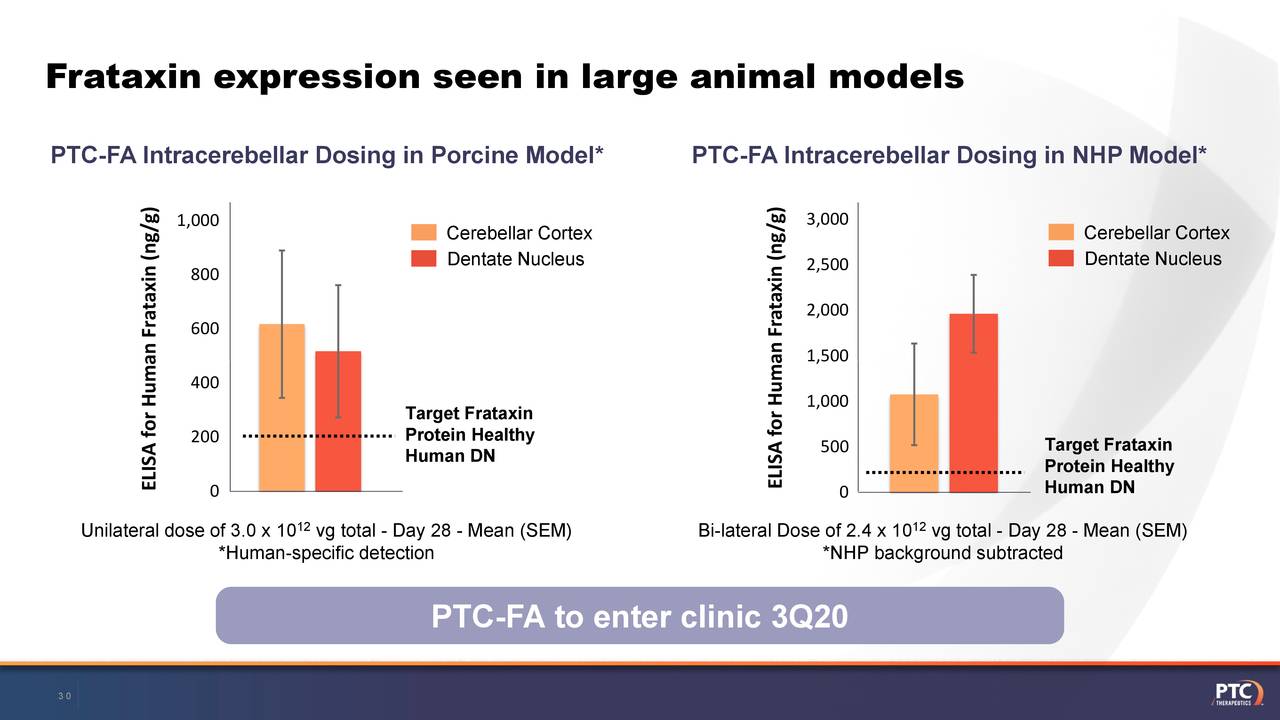
Slide deck was published by PTC Therapeutics, Inc. in conjunction with this event.
Thursday, January 16, 2020
Novartis' David Lennon on next steps for AveXis, selling Zolgensma's price to the public
BioPharma Dive (WEB 01/16/2020)
SAN FRANCISCO — Novartis sparked a new round of drug pricing criticism last May when the Swiss pharma revealed its new gene therapy Zolgensma would cost $2.1 million per patient.
Pipeline products to prioritize: "Those programs existed as part of the acquisition of AveXis. Since then, we started partnering with [the Novartis Institutes of Biomedical Research] to apply this platform to different diseases. The first one we announced is a project for Friedreich's ataxia, a muscle-wasting disease."
SAN FRANCISCO — Novartis sparked a new round of drug pricing criticism last May when the Swiss pharma revealed its new gene therapy Zolgensma would cost $2.1 million per patient.
Pipeline products to prioritize: "Those programs existed as part of the acquisition of AveXis. Since then, we started partnering with [the Novartis Institutes of Biomedical Research] to apply this platform to different diseases. The first one we announced is a project for Friedreich's ataxia, a muscle-wasting disease."
Safety and Efficacy of Interferon γ in Friedreich's Ataxia
Marinela Vavla MD PhD Maria Grazia D'Angelo MD PhD Filippo Arrigoni MD Nicola Toschi PhD Denis Peruzzo PhD Sandra Gandossini MD Annamaria Russo MD Eleonora Diella Stefania Tirelli PhD Roberto Salati MD Paolo Scarpazza MD Riccardo Luffarelli PhD Silvia Fortuni PhD Alessandra Rufini PhD Ivano Condò PhD Roberto Testi MD Andrea Martinuzzi MD PhD; Mov Disord. 2020 doi:10.1002/mds.27979
A relevant indication that emerges from the study, the previously studies, and from the numerous FRDA patients using IFNγ off label is the possible presence of nonresponders. A randomized withdrawal design is therefore best suited to increase the power of future clinical trials to definitively assess the efficacy of IFNγ treatment in FRDA
A relevant indication that emerges from the study, the previously studies, and from the numerous FRDA patients using IFNγ off label is the possible presence of nonresponders. A randomized withdrawal design is therefore best suited to increase the power of future clinical trials to definitively assess the efficacy of IFNγ treatment in FRDA
Wednesday, January 15, 2020
Predictors of loss of ambulation in Friedreich's ataxia
Christian Rummey, Jennifer M. Farmer, David R. Lynch; EClinicalMedicine, Volume 18, 2020, 100213, doi:10.1016/j.eclinm.2019.11.006.
We propose a stratification paradigm for time to LoA in FRDA. Concurrently, each step in a sequence of events represents a surrogate measure for future LoA. This will facilitate patient selection and stratification in clinical trials, and potentially enable study of LoA as a direct clinical outcome.
We propose a stratification paradigm for time to LoA in FRDA. Concurrently, each step in a sequence of events represents a surrogate measure for future LoA. This will facilitate patient selection and stratification in clinical trials, and potentially enable study of LoA as a direct clinical outcome.
Tuesday, January 14, 2020
PTC Therapeutics Provides Corporate Update and Highlights Pipeline Progress at 2020 J.P. Morgan Healthcare Conference
SOUTH PLAINFIELD, N.J., Jan. 13, 2020 /PRNewswire/ -- PTC Therapeutics, Inc. (NASDAQ: PTCT) today is providing a corporate update that will be presented at the 38th Annual J.P. Morgan Healthcare Conference on Wednesday, January 15th at 8:30 a.m.
PTC-FA gene therapy for Friedreich ataxia is progressing and is anticipated to enter the clinic in 3Q 2020.
In order to control and accelerate its gene therapy platform, PTC secured a 15-year lease on ~185,000 sq. ft. of space, which includes a state-of-the-art biologics production facility with supporting research and operations buildings in NJ. PTC expects manufacturing to begin at this facility in 2020.
PTC-FA gene therapy for Friedreich ataxia is progressing and is anticipated to enter the clinic in 3Q 2020.
In order to control and accelerate its gene therapy platform, PTC secured a 15-year lease on ~185,000 sq. ft. of space, which includes a state-of-the-art biologics production facility with supporting research and operations buildings in NJ. PTC expects manufacturing to begin at this facility in 2020.
MDA Awards Venture Philanthropy Funding of More Than $1M to AavantiBio to Develop Gene-Targeting Therapy for Friedreich's Ataxia
NEW YORK and GAINESVILLE, Fla., Jan. 13, 2020 /PRNewswire/ -- The Muscular Dystrophy Association (MDA) and AavantiBio, a biotechnology company developing a gene-targeting therapy for Friedreich's ataxia (FA), today announced the award of MDA Venture Philanthropy (MVP) funding totaling $1,076,232 to advance AavantiBio's phase 2 clinical trial of a gene-replacement therapy for the disease.
MDA's investment will help accelerate AavantiBio's mission and begin production of the clinical gene vector for its therapy program. Clinical trials are expected to begin in 2020.
MDA's investment will help accelerate AavantiBio's mission and begin production of the clinical gene vector for its therapy program. Clinical trials are expected to begin in 2020.
Monday, January 13, 2020
Mammalian iron–sulfur cluster biogenesis: Recent insights into the roles of frataxin, acyl carrier protein and ATPase-mediated transfer to recipient proteins
Nunziata Maio, Anshika Jain, Tracey A. Rouault; Current Opinion in Chemical Biology, Volume 55, 2020, Pages 34-44, doi:10.1016/j.cbpa.2019.11.014.
Highlights:
Iron–sulfur (Fe–S) clusters (ISCs) are metal cofactors involved in multiple, essential cellular processes.
Defined pathways assemble ISCs de novo in mammalian mitochondria and cytosol.
The acyl carrier protein is a component of the core ISC machinery.
Frataxin is an allosteric regulator that accelerates sulfur transfer from NFS1 to ISCU.
A chaperone/cochaperone system facilitates cluster transfer downstream of ISCU.
Insights into the role of FXN in FeeS biogenesis have arisen from recent structural and biochemical studies, an important future direction will be to search for drugs that can mimic FXN activity to treat patients with Friedreich’s ataxia, a disease caused by low FXN expression. The source of iron for Fe-S biogenesis remains unsettled, and future work will likely focus on how iron is delivered to the Fe-S biogenesis machinery. Much progress has been made, but many basic questions remain unanswered in the complex process of mammalian Fe-S biogenesis
Highlights:
Iron–sulfur (Fe–S) clusters (ISCs) are metal cofactors involved in multiple, essential cellular processes.
Defined pathways assemble ISCs de novo in mammalian mitochondria and cytosol.
The acyl carrier protein is a component of the core ISC machinery.
Frataxin is an allosteric regulator that accelerates sulfur transfer from NFS1 to ISCU.
A chaperone/cochaperone system facilitates cluster transfer downstream of ISCU.
Insights into the role of FXN in FeeS biogenesis have arisen from recent structural and biochemical studies, an important future direction will be to search for drugs that can mimic FXN activity to treat patients with Friedreich’s ataxia, a disease caused by low FXN expression. The source of iron for Fe-S biogenesis remains unsettled, and future work will likely focus on how iron is delivered to the Fe-S biogenesis machinery. Much progress has been made, but many basic questions remain unanswered in the complex process of mammalian Fe-S biogenesis
Friday, January 10, 2020
Retrotope Expands its Drug Pipeline with the First Dosing of RT001 in patients with Friedreich’s ataxia (FA)
LOS ALTOS, Calif., Jan. 09, 2020 (GLOBE NEWSWIRE) -- Retrotope announced today that it has dosed its first patient in a Phase 2/3 clinical trial of RT001 in Friedreich’s ataxia, the most common of the inherited ataxias. RT001, a stabilized fatty acid drug, has been shown to reduce lipid peroxidation leading to cell death in patients across a wide swath of degenerative diseases, including FA.
“This Phase 2/3 clinical trial is an important milestone in the development pathway of RT001” commented Peter G Milner, MD of Retrotope. “We believe the CPET is a very sensitive probe of the mitochondrial function and stamina of patients with this disease who suffer from profound fatigue due to mitochondrial neuropathy, myopathy and cardiomyopathy. FDA has agreed with us that CPET may be a primary endpoint in a marketing approval study, and will be evaluated for approval with other secondary, supportive efficacy measures and validated scales important to patient function.”
“This Phase 2/3 clinical trial is an important milestone in the development pathway of RT001” commented Peter G Milner, MD of Retrotope. “We believe the CPET is a very sensitive probe of the mitochondrial function and stamina of patients with this disease who suffer from profound fatigue due to mitochondrial neuropathy, myopathy and cardiomyopathy. FDA has agreed with us that CPET may be a primary endpoint in a marketing approval study, and will be evaluated for approval with other secondary, supportive efficacy measures and validated scales important to patient function.”
Subscribe to:
Posts (Atom)

